
Product
Updated · 5 min read
Introducing Thally
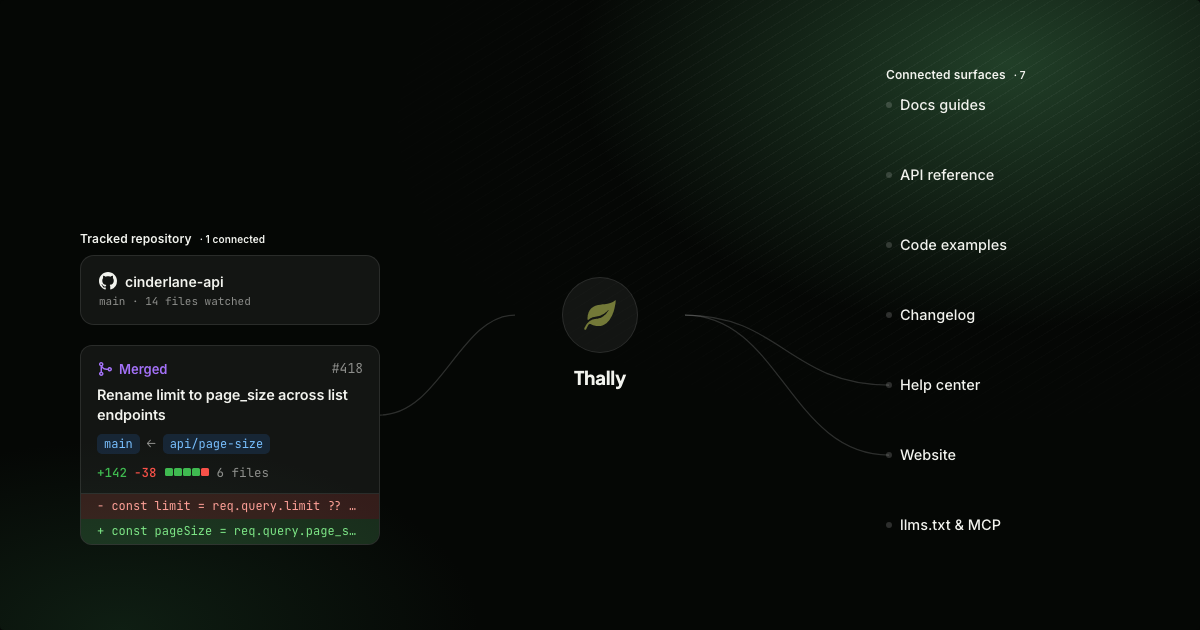
Thally turns product changes into evidence-backed updates across connected docs, websites, support platforms, and other places users learn about your product.
Updated · 6 min read
Compare Thally's product-linked docs workflow with GitBook's hosted knowledge base across authoring, Git, AI-readable output, migration, and collaboration.
The short answer: GitBook is a hosted knowledge base with a polished WYSIWYG editor, ideal when most authors are not developers. Thally is a product knowledge synchronization pipeline that starts with a docs-as-code engine, structured output for AI agents, and reviewable updates from product changes. If your customer-facing knowledge should follow the product from Git, Thally is the better fit. If your priority is a friendly destination for a mixed writing team, GitBook is a fine choice.
Every documentation tool optimizes for someone. GitBook optimizes for the writer in the browser: block-based editing, comments, change requests, and a git sync feature for teams that want both worlds. Thally optimizes for the connection between the product, its knowledge, and each reader: MDX in Git, product-change evidence, pull-request review, and every page published as data as well as HTML.
Neither is wrong. They are different bets about where documentation should live.
| Thally | GitBook | |
|---|---|---|
| Authoring model | MDX in a git repo, PR review | WYSIWYG editor, optional git sync |
| License | MIT, open source | Proprietary |
| Self-hosting | Yes, free | No |
| Machine output | JSON, JSON-LD, Markdown, HTML per page | HTML-first |
| MCP server | Every deploy, /api/mcp | Not a core feature; check current docs |
| API reference | Generated from OpenAPI with Try-It console | OpenAPI support on the platform |
| Docs automation | Agent drafts reviewed PRs from product changes | AI assistant features in the editor |
| Best for | Developer docs, agent traffic, self-hosters | Internal wikis, mixed technical teams |
GitBook ships new features regularly; their documentation is the source of truth for current capabilities.
If your writers are engineers, docs-as-code wins on friction: the docs PR rides along with the code PR, review happens in one place, and CI can block a release when documentation is missing. Thally leans into this fully. Even the admin dashboard writes through git, so every edit is a reviewed pull request with an audit trail.
If your writers are support, product, or marketing people who do not want to see git, GitBook's editor is genuinely excellent, and its change-request workflow gives non-developers a review process that feels like suggestions in a document rather than a diff.
The honest question is: who writes, and who reviews? Answer that and this section decides itself.
AI agents now read documentation to answer developer questions, compare products, and build integrations. Those readers do not render your CSS. Serving them structured content is a core Thally design goal:
GitBook publishes clean HTML and continues to add AI features to its platform. If agent traffic is a first-class audience, the practical difference is whether structured output ships by default or whether agents begin with rendered HTML.
Thally Free includes one managed documentation site per workspace with pull-request previews, documentation analytics, unlimited pages, and unlimited readers. The MIT-licensed engine can also be self-hosted for free. Thally Cloud is $199 per workspace per month or the equivalent of $166 per month with $1,990 billed annually. Both options include three managed sites, unlimited connected product repositories, 10,000 shared AI credits each month with rollover, and five team members. Additional members are $20 per month or $200 per year, additional managed sites are $39 per month or $390 per year, and a one-time $79 pack adds 10,000 AI credits without automatic top-ups. Thally Cloud also includes AI answers, Thally Track, custom domains, team roles, and the dashboard. Enterprise pricing is custom with allowances and contract terms scoped to each customer. Details are on the pricing page.
GitBook is a hosted product with per-user pricing, so check its pricing page for current tiers. The main structural difference is ownership: GitBook operates the platform, while a Thally site remains a repository you can deploy yourself.
Choose Thally if:
Choose GitBook if:
The migrator imports GitBook content, converts pages to MDX, and rebuilds your navigation:
npx create-thally-docs migrate <your-docs-source>
You review the converted site locally before switching DNS. Create your docs site, or ask us anything via the contact page.
GitBook capabilities were checked against its AI documentation overview and official documentation. Thally capabilities and prices were checked against the current product repository, documentation, and machine-readable pricing. Sources were last verified July 24, 2026. Read our editorial policy for the comparison process.
Published under the Thally editorial policy. Technical conformance is defined in the agent-readiness methodology.
Create a managed site, or use the open-source engine to run Thally yourself.