
Product
Updated · 5 min read
Introducing Thally
Thally turns product changes into evidence-backed updates across connected docs, websites, support platforms, and other places users learn about your product.
Updated · 8 min read
Compare Thally and Mintlify across ownership, machine-readable output, code-to-docs automation, deployment, migration, and pricing.
The short answer: Mintlify and Thally both publish polished MDX documentation, serve agent-readable content, and can turn code changes into documentation pull requests. Choose Thally if you want an MIT-licensed engine you can self-host for free, structured JSON and JSON-LD output, and mandatory human review for automated changes. Choose Mintlify if you want a proprietary managed platform that can generate a first site from a code repository and run broader automations from repository changes, schedules, or connected tools.
Mintlify and Thally both publish developer documentation from MDX, generate API references from OpenAPI specifications, provide search and AI answers, expose MCP servers, generate llms.txt, and serve Markdown versions of published pages.
Both platforms also address documentation drift. Mintlify Automations can read connected code repositories, identify documentation affected by merged changes, and open pull requests. Thally Track evaluates merged product changes against the current documentation and prepares an evidence-backed pull request when an update is needed.
The comparison gets interesting one level down.
| Thally | Mintlify | |
|---|---|---|
| Source model | Docs-as-code in a deployable Next.js project | Docs-as-code on a proprietary platform |
| License | MIT, open source | Proprietary platform |
| Self-hosting | Yes, free forever | Listed as an Enterprise option |
| Machine output | JSON, JSON-LD, Markdown, and HTML from each page URL | Markdown and HTML from each page URL |
| MCP server | Search and readiness tools at /api/mcp on every deploy | Hosted search MCP per site, plus an authenticated admin MCP |
| llms.txt | llms.txt and llms-full.txt generated on every build | llms.txt and llms-full.txt generated automatically |
| Starting point | Migrate supported existing documentation into an editable Thally project | Generate a first documentation site directly from a GitHub code repository |
| Docs automation | Track evaluates product changes and opens PRs for human review | Automations can react to code changes, schedules, content changes, or Enterprise integration events, then open PRs or merge directly |
| Automation availability | Track is included with Thally Cloud | Automations require Pro or Enterprise |
| Pricing model | Free includes 1 managed site per workspace; Thally Cloud is $199/month or $1,990/year with 3 managed sites and 5 team members | Free Starter; Pro is $540/month with Monthly selected or $450/month with Annual selected; Enterprise is custom |
| Included AI credits on paid plan | 10,000 per month | 10,000 per month; additional credits are $0.01 each |
| Included team access | 5 workspace members; additional members are $20/month or $200/year each | Unlimited editor seats |
| Portability | Content, renderer, and static export remain yours | Content stays in Git; the renderer and platform are proprietary |
Mintlify moves quickly and its capabilities evolve; treat their current documentation as the source of truth for their side of this table.
Mintlify can generate a first documentation site directly from a GitHub code repository. Its announced workflow reads the codebase and produces a publishable draft with API references, getting-started guides, and configuration pages. You review the result, publish it, and then configure Automations to maintain it. If you have working code but no documentation, Mintlify offers the more direct built-in starting point.
Thally's automated starting path is migration rather than code-to-site generation. It converts supported existing documentation into an editable MDX project, rebuilds the navigation, and detects an OpenAPI specification when available. It is designed for teams moving an existing docs site while taking the publishing engine with them.
A Thally site is a Next.js repository. You can read every line that serves your docs, deploy it to Vercel, Netlify, Cloudflare, Docker, or a static bucket, and leave with a working site. The engine is MIT licensed, so self-hosting is free forever, commercial use included.
Mintlify hosts and maintains Starter and Pro deployments, which removes infrastructure and upgrade work from your team. Its current pricing page also lists self-hosting as an Enterprise option. Your MDX content stays in Git in either model, but Mintlify's renderer and platform remain proprietary.
Which tradeoff is right depends on your team. Choose Thally when open-source ownership and deployment flexibility matter most. Choose Mintlify when a vendor-operated platform, or a supported Enterprise deployment, matters more than owning the publishing engine.
Both platforms now publish content specifically for machine readers. Mintlify automatically generates Markdown for every page, supports the Accept: text/markdown header, publishes llms.txt and llms-full.txt, and provides a hosted search MCP at /mcp. Its authenticated admin MCP can also edit content, change settings, create automations, and open pull requests.
Every page on a Thally site is available as rendered HTML, JSON, JSON-LD, or Markdown from the same URL, selected by an Accept header or a ?format= parameter. An agent can request typed structure instead of extracting it from presentation markup.
On top of that, every deploy ships:
/api/mcp, so agents can call search_docs, read_page, and list_pages as native toolsMintlify also offers an Agent Score that tests whether an agent can find, parse, and use a documentation site. Thally runs its agent-readiness score as a deterministic build check that can gate CI. The remaining structural difference is the output and deployment model: Thally adds JSON and JSON-LD, and its machine layer is part of the open-source engine on self-hosted and managed deployments.
Documentation starts drifting when the product changes. The two platforms address that problem differently.
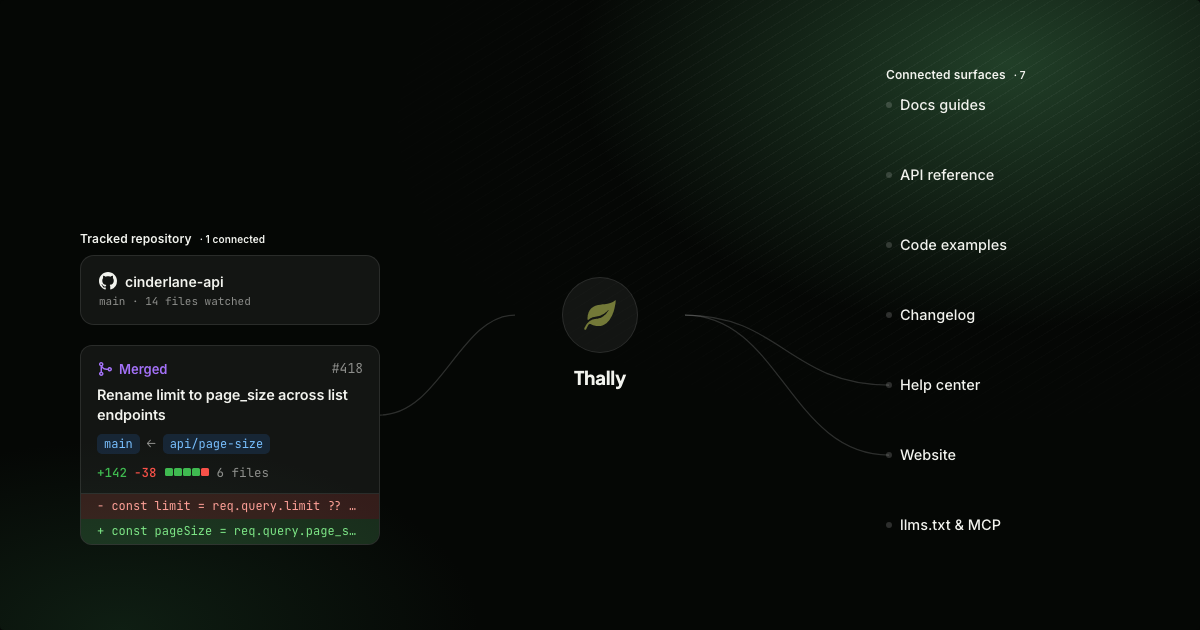
Thally treats drift as a product-understanding problem. After a Thally docs repository is connected, mention @thally document this on a GitHub issue or PR to request a documentation pull request. Once a site is live and product repositories are mapped, Track evaluates merged product PRs, gathers evidence, and can draft a docs PR when the documentation needs to change. No change is a valid result, and nothing merges without a human.
Mintlify now has a comparable code-to-docs loop. Its Automations can run when a code pull request merges, on a schedule, after a content update, or, on Enterprise, from an integration event. The agent reads the documentation and connected repositories, then opens or updates a pull request with a summary and citations to source changes. For GitHub, it can assign reviewers based on who authored the triggering code changes. A run can also finish with no action needed.
The products differ more in scope and guardrails than in whether they automate maintenance. Thally centers on evaluating product changes and always leaves the merge to a person. Mintlify offers a broader configurable automation system for code updates, changelogs, translations, broken links, style checks, support feedback, and other recurring work. Teams can require review or allow some automations to merge directly.
Thally Free includes one managed documentation site per workspace with pull-request previews, documentation analytics, unlimited pages, and unlimited readers. The MIT-licensed engine can also be self-hosted for free. Thally Cloud is $199 per workspace per month or the equivalent of $166 per month with $1,990 billed annually. Both options include three managed sites, unlimited connected product repositories, 10,000 shared AI credits each month with rollover, and five team members. Additional members are $20 per month or $200 per year, additional managed sites are $39 per month or $390 per year, and a one-time $79 pack adds 10,000 AI credits without automatic top-ups. Thally Cloud also includes cited AI answers, reviewable updates drafted from relevant product changes through Track, custom domains, team roles, and the Cloud dashboard. Enterprise pricing is custom with allowances and contract terms scoped to each customer. Readers are never billed. Full details are on the pricing page.
Mintlify's Starter plan is free and includes five editor seats, Git sync, search, and an MCP server. Pro is $540 per month with Monthly selected or $450 per month with Annual selected. It includes unlimited editor seats, the agent, assistant, Automations, preview deployments, admin APIs, and 10,000 agent credits per month. Additional credits cost $0.01 each, and Enterprise pricing is custom. Their pricing page is the source of truth for current prices and packaging.
Choose Thally if:
Choose Mintlify if:
If you decide to switch, the migrator does the heavy lifting:
npx create-thally-docs migrate github.com/acme/docs
It detects supported source platforms, converts the docs to MDX, rebuilds navigation, carries supported redirects, and detects an OpenAPI spec when available. You get a local preview before changing DNS. Create your docs site or read more in the FAQ.
Mintlify capabilities were checked against Docs on autopilot, its Automations documentation, agent-ready content documentation, MCP documentation, Agent Score, and pricing page. Thally capabilities and prices were checked against the current product repository, documentation, and machine-readable pricing. Sources were last verified August 18, 2026. Read our editorial policy for the comparison process.
Published under the Thally editorial policy. Technical conformance is defined in the agent-readiness methodology.
Create a managed site, or use the open-source engine to run Thally yourself.