
Product
Updated · 5 min read
Introducing Thally
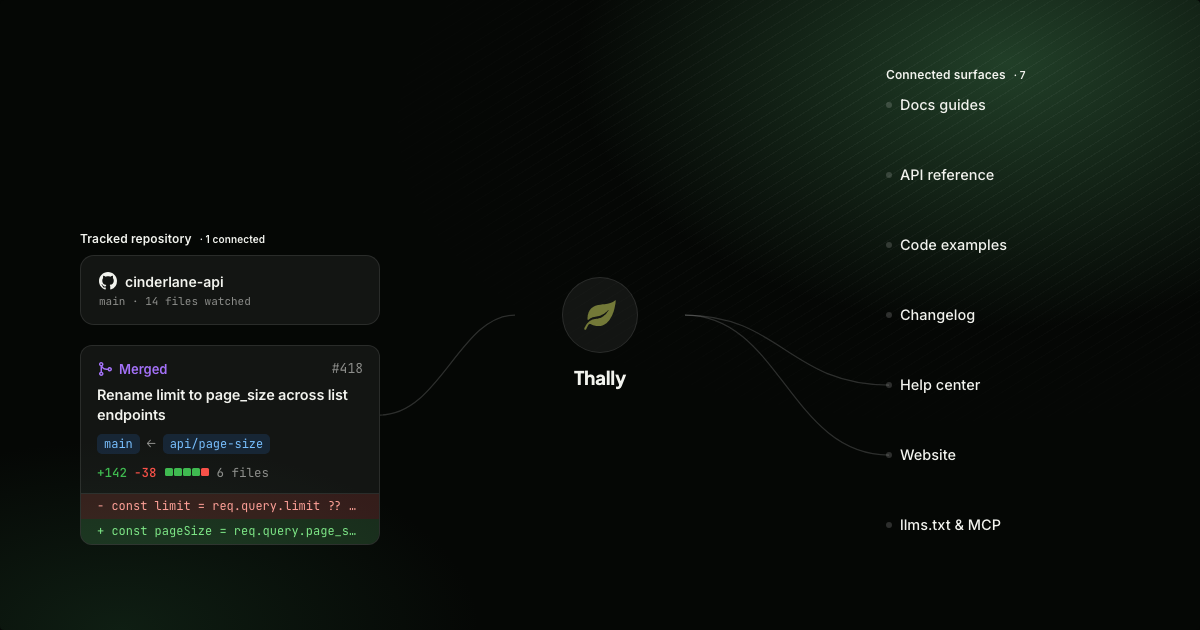
Thally turns product changes into evidence-backed updates across connected docs, websites, support platforms, and other places users learn about your product.
Updated · 5 min read
Learn what AI-native documentation means, how it differs from AI-assisted writing, and how to test discovery, structure, freshness, and agent access.
AI-native documentation is documentation published in machine-readable structures (JSON, JSON-LD, Markdown) alongside the human-readable page, from the same URL, with discovery files and live endpoints that let AI agents find, read, and cite it without scraping. It is not documentation written by AI. It is documentation that machines can read as reliably as people can.
Many documentation requests now come through coding assistants, research agents, and answer engines. These systems resolve API questions, compare products, and decide which sources to cite without rendering your CSS.
Traditional HTML makes that audience do extra work. An agent has to strip navigation, locate the main content, reconstruct code blocks, and handle client-rendered pages. Each reconstruction step creates another opportunity to lose context.
AI-native documentation removes the guesswork by serving structure on request.
The same URL that renders HTML for a person returns structured data for a machine, selected by an Accept header or a query parameter:
curl https://docs.example.com/quickstart \
  -H "Accept: application/json"
The response carries the page as data: title, description, section, body as both MDX and plain text, code blocks with languages, and provenance dates. JSON-LD gives answer engines the same content as schema.org markup, and Markdown serves agents that want prose.
Machines need a map. AI-native sites publish:
These files are inexpensive to generate and give crawlers a direct map to your primary documentation. Without them, an agent may find a secondary source before it finds your quickstart.
The strongest form is an API the agent can call. With MCP (Model Context Protocol), a docs site exposes tools like search_docs, read_page, and list_pages. An agent attached to the endpoint queries your documentation the way your own search does, with no scraping and no stale index.
Thally ships all three layers on every deploy, self-hosted included; that is the design goal behind the platform. But the definition is bigger than any one product, and you can meet it with your own stack if you are willing to build and maintain the pieces.
Run these five checks against your own site:
curl -H "Accept: application/json" on a docs URL return structured data?/llms.txt exist and describe your product accurately?If you can answer yes to all five, your docs give agents a reliable path to the source. Each "no" identifies a point where an agent may have to infer structure or use an indirect source.
A deterministic version of this checklist is what Thally's agent-readiness score grades on every build, from 0 to 100, so CI can enforce it. You can start free and see your own score in minutes.
This article follows the Thally editorial policy and was last reviewed July 19, 2026.
Published under the Thally editorial policy. Technical conformance is defined in the agent-readiness methodology.
Create a managed site, or use the open-source engine to run Thally yourself.