
Product
Updated · 5 min read
Introducing Thally
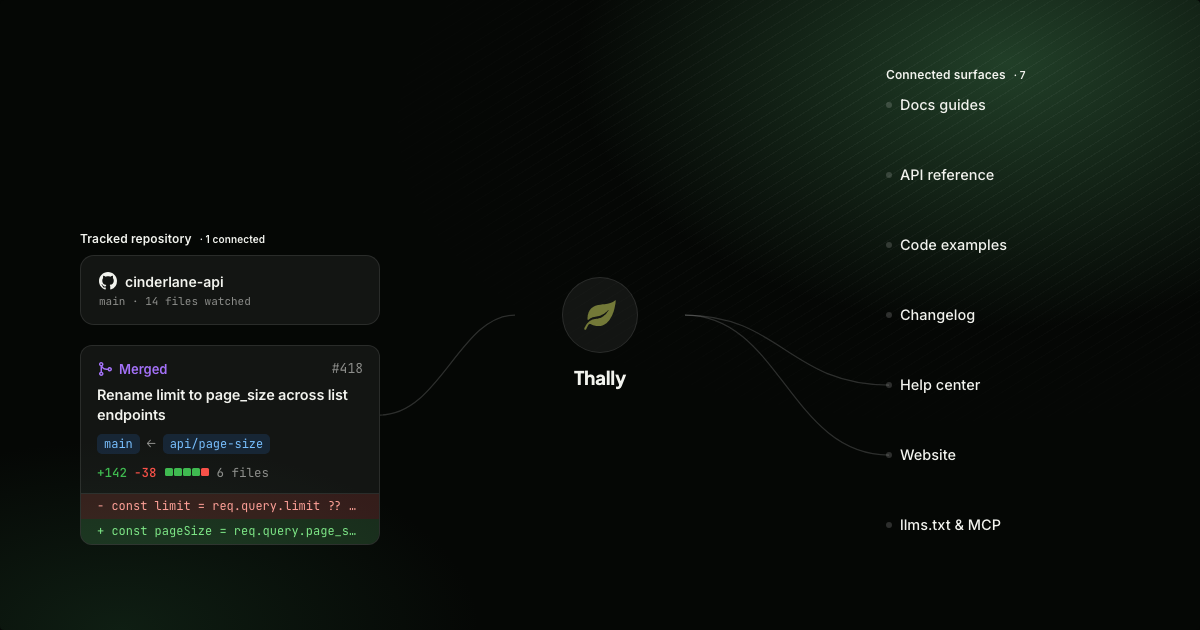
Thally turns product changes into evidence-backed updates across connected docs, websites, support platforms, and other places users learn about your product.
Updated · 8 min read
Build agent-readable documentation with crawlable HTML, llms.txt, structured page formats, content negotiation, MCP, provenance, and repeatable tests.
The short version: agent-ready documentation has three layers. Discovery files (llms.txt, sitemaps) so agents can find you. Structured per-page output (JSON, Markdown, JSON-LD) so agents can read you without scraping. Live endpoints (MCP) so agents can query you like a tool. This guide walks through each layer, in order of effort, with checks to prove each one works.
When a developer asks their coding assistant "how do I rotate an API token in Acme?", the assistant reads documentation on their behalf. Clean structure gives it reliable source material. Without that structure, the agent has to reconstruct the answer from scraped HTML. Machine readability now affects how accurately other systems explain your product.
The good news: the work is layered, and the first layer takes an afternoon.
Add a plain-markdown file at your site root that tells AI systems what your product is and where the important pages are:
# Acme

> Acme is a payments API for marketplaces. This site documents
> the REST API, SDKs, and webhooks.

## Key pages

- [Quickstart](/quickstart): first charge in five minutes
- [API reference](/api): every endpoint, with examples
- [Webhooks](/webhooks): events, retries, signatures
Keep it under a few hundred lines, keep it current, and write it like an abstract, not a sitemap dump. The spec lives at llmstxt.org.
Decide which AI crawlers you want reading your site, and state that policy explicitly. If you want GPTBot, ClaudeBot, or PerplexityBot to crawl your docs directly, allow the corresponding user agent. A blocked crawler may have to rely on other indexed sources.
Check: curl https://yoursite.com/llms.txt returns your file, and your robots.txt names the crawlers you care about.
The goal: the same URL that serves your HTML also serves the page as data.
# A person gets HTML. An agent gets structure.
curl https://docs.acme.com/quickstart -H "Accept: application/json"
curl https://docs.acme.com/quickstart?format=md
The JSON should carry the page as content, not markup: title, description, section, plain-text body, code blocks with their languages, and provenance dates (lastUpdated, lastVerified). JSON-LD adds schema.org semantics for answer engines; Markdown serves agents that want prose they can quote.
Two implementation rules that save pain:
This layer is the expensive one to hand-roll, and it is the core of what an AI-native platform gives you for free. Every page on a Thally site ships all four formats from one content graph on every build.
Check: pick three pages and diff the JSON body text against the rendered page. They should match exactly.
MCP (Model Context Protocol) lets an agent attach to your docs as a set of callable tools rather than a pile of URLs. A docs MCP server typically exposes:
search_docs(query): ranked results from your real indexread_page(slug): the structured page contentlist_pages(): the site map as dataThe practical difference is freshness and control. An agent with MCP access queries your live content through your search ranking. Without it, the agent may depend on an older crawler index.
Every deployed Thally site exposes /api/mcp with those tools plus agent_readiness, no key or account required. If you are building your own, the MCP spec and SDKs are open; budget for auth decisions, rate limits, and keeping the index fresh.
Check: attach the endpoint to any MCP-capable agent and ask it a question only your docs can answer. It should cite the right page.
Ad-hoc checks rot. Turn the layers above into a score your CI understands:
| Dimension | What it checks |
|---|---|
| Structured data | JSON/JSON-LD/Markdown parity per page |
| Metadata | titles, descriptions, provenance dates |
| Discovery | llms.txt, sitemap, robots, manifests |
| Machine readability | content negotiation, clean plain text |
| OpenAPI coverage | endpoints documented vs. spec |
Thally turns these checks into an agent-readiness score from 0 to 100 on every build. You can gate CI on a threshold and ask the docs agent to draft fixes for low-scoring pages. Whatever stack you use, measuring the checks makes regressions visible.
Start with llms.txt and an explicit robots.txt policy. Then decide whether layers 2 and 3 are infrastructure your team wants to build or a platform you want to adopt. Migrating an existing docs site into Thally takes one command, and the free plan self-hosts forever:
npx create-thally-docs migrate github.com/acme/docs
Related reading: What is AI-native documentation?
This guide follows the Thally editorial policy and was last reviewed July 19, 2026.
Published under the Thally editorial policy. Technical conformance is defined in the agent-readiness methodology.
Create a managed site, or use the open-source engine to run Thally yourself.